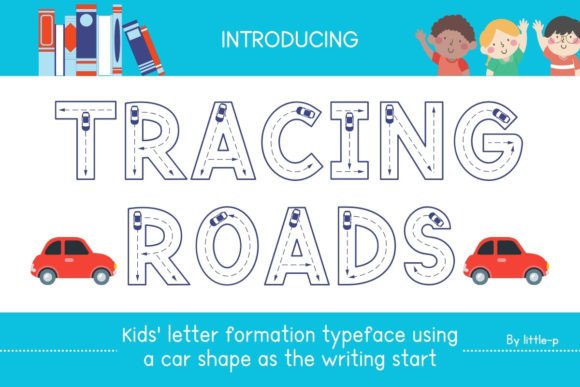
Tracing Roads: A Playful Font for Engaging Learning
When you think of a premium font, the mind often drifts to elegant serifs or clean sans serifs. But what if a font's primary value isn't just in its aesthetic refinement, but in its direct, functional impact on a core human skill? This is where Tracing Roads carves its unique niche. It’s not your typical display font; it's a purpose-built educational tool disguised as a creative adventure. Imagine a child's first steps into letter formation, not as a series of abstract lines, but as a journey where every letter begins with the familiar, friendly shape of a car. That’s the core concept: the starting point for tracing each character is a little automobile, transforming the learning process into a game of following roads.
Visual Personality and Design Appeal
At its heart, Tracing Roads is a handwritten font with a clear, instructional style. The letterforms are intentionally simple, with rounded edges and consistent stroke widths, making them easy for small hands to trace. The visual twist—the car motif—is integrated seamlessly. It doesn't overwhelm the letter but acts as a clever guidepost. The personality is undeniably playful, energetic, and encouraging. It speaks directly to a child's sense of fun while fulfilling a practical educational need. For designers, this isn't just another creative font; it's a specialized design asset that solves a specific problem: making foundational learning visually engaging.
Beyond the Classroom: Unexpected Applications
While its primary audience is clear, the applications of Tracing Roads extend beyond traditional worksheets. Consider its potential in brand identity for businesses focused on children's products, educational apps, or family-friendly entertainment. A logo using this typeface immediately communicates approachability and a child-centric focus. In packaging design for educational toys or books, it can create an instant connection with the end-user—the child—and the purchasing adult.
For content creators and bloggers in the parenting or education space, this font becomes a powerful tool for creating engaging social media graphics. A simple quote about learning or a motivational message for young students, set in Tracing Roads, gains an inherent narrative of growth and journey. It’s also a fantastic choice for editorial design in children’s magazines or activity books, where the text itself becomes part of the interactive experience.
Strategic Influence on Communication
Choosing a typeface is a strategic decision that influences perception. Tracing Roads doesn't aim for corporate professionalism; it aims for trusted guidance. Its use signals that content is accessible, supportive, and designed with the learner's experience in mind. This can profoundly affect audience engagement. For a homeschooling parent creating custom materials, or a teacher designing a bulletin board, this font creates an immediate, positive brand perception of care and creativity.
However, its strength is also its limitation. Its very specificity means it won't work for every project. Using it for a law firm's website would be a jarring mismatch. This is where understanding visual hierarchy and context is key. Tracing Roads should be used as an accent—a headline font for titles on a learning app, or for key instructional text—not as the body copy for a lengthy report. Its readability at small sizes for extended reading may not match that of a well-designed sans serif font.
Practical Guide for Using This Typeface
If you're considering integrating Tracing Roads into your toolkit, here’s a practical approach:
- Evaluate Project Fit: Ask yourself if your project has a direct connection to childhood education, play, or foundational learning. If the answer is yes, it's a strong candidate. For general web design or editorial design for adult audiences, look elsewhere.
- Test Font Pairings: This is crucial. Pair it with a neutral, highly readable sans serif font for body text. A clean typeface like Open Sans or Lato can provide a stable, professional foundation that lets the playful character of Tracing Roads shine without causing visual chaos. Avoid pairing it with other decorative or script fonts.
- Review Included Styles: Check what the font package offers. Does it include multiple weights? Are there additional glyphs or stylistic alternates that enhance its utility? Knowing the full scope of the commercial font package helps you plan its use across various materials.
- Prioritize Readability: Always test it in context. Print a sample worksheet. View it on a screen at the size it will be used. Ensure the car motif doesn't interfere with letter recognition, especially for complex letters like 'a' or 'g'.
- Understand Licensing: For any project that will be distributed or used commercially—whether it's a product you sell, a client's website, or materials for a paid course—you need to ensure you have the correct commercial license. Respect the creator's terms to avoid legal issues.
In the vast landscape of modern typography, Tracing Roads stands out by refusing to be just another pretty face. It’s a functional, joyful, and highly specific tool. Its value lies not in being the most versatile serif font or the most stylish script font, but in being the perfect solution for a very particular kind of communication: one that guides, encourages, and makes the first steps of learning feel like the start of a great adventure. For designers, educators, and creators working within that space, it’s an invaluable addition to the font library.